Acne scars can fade, but they rarely go away completely on their own. The redness or darkness around a new scar usually settles over time, while the indent or raised scar itself remains. Treatments such as microneedling, chemical peels, lasers, fillers and minor scar surgery can make acne scars much less noticeable, and dermatologists often combine more than one.
This guide explains why acne scars form, how to tell a scar from a dark mark, which treatments suit which scars, and how to prevent new ones.
Why do acne scars form?
The American Academy of Dermatology (AAD) explains that when a breakout clears, the skin starts to heal. Often it heals in seven to 10 days without a trace. A scar is more likely when:
- the acne went deep into the skin, such as a painful cyst or nodule;
- the breakout was picked, popped, squeezed or scratched, which increases inflammation;
- a close blood relative has acne scars, because the tendency to scar can run in families.
The type of scar depends on how much collagen the body makes while healing. Too little leaves a depression or pit; too much leaves a raised scar. The AAD notes that raised acne scars are more common in people with darker skin tones.
Is it a scar or a dark mark?
This matters, because the treatment is different. The AAD says a flat spot of colour left after acne clears is usually not a scar but post-inflammatory hyperpigmentation, which tends to fade over time. A scar changes the surface of the skin: an indent, or a raised bump.
Do they fade on their own?
Partly. When a scar first appears you may see an indent or raised area along with some discolouration. Over time the discolouration usually goes away, but the scar itself remains, according to the AAD. Treatment is what reduces the scar.
Treatments for depressed (sunken) acne scars
Most acne scars are depressed. The AAD lists these treatments, and says dermatologists often use more than one:
| Treatment | How it helps |
|---|---|
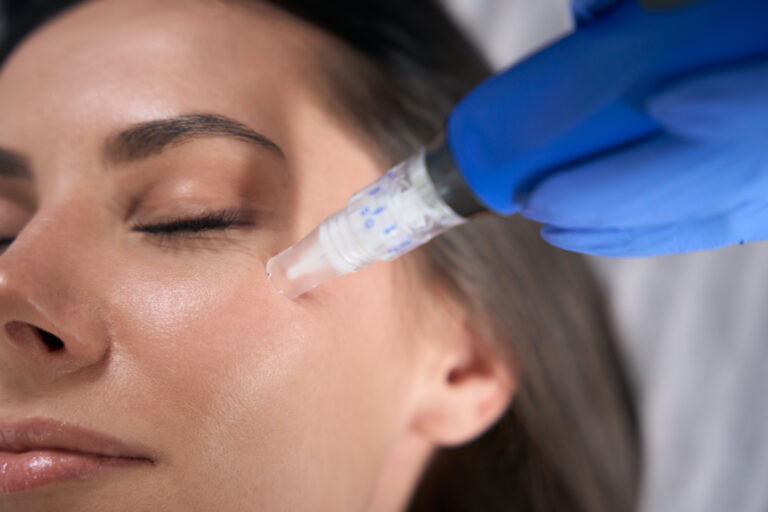
| Microneedling | Tiny punctures prompt new collagen and elastin; often combined with radiofrequency, a peel or platelet-rich plasma |
| Radiofrequency microneedling | Adds heat; together they can give less noticeable scars than either alone |
| Chemical peel | Helps the skin make more collagen and elastin; mild peels usually need three to five treatments, two to four weeks apart |
| Laser treatment | Resurfaces the skin, or contours the skin around scars |
| Fillers | Add volume to depressed scars; most last three months to two years |
| Scar surgery | Removes a scar, or frees it from the tissue below so the skin rises |
| Retinoid or salicylic acid | Can make mild scarring less noticeable |
The AAD also describes platelet-rich plasma as a way to enhance another treatment such as microneedling, and says studies show the combination can lead to less visible scarring.
Microneedling for acne scars
The SkinPen microneedling device is FDA-authorized for improving the appearance of facial acne scars. The AAD says microneedling is safe for all skin tones. Our guide to SkinPen microneedling covers the clinical study and who should avoid it, and our comparison of microneedling and RF microneedling explains the difference, including the FDA’s 2025 safety notice about radiofrequency microneedling.
Treatments for raised scars
Raised scars form from too much collagen, so they need a different approach. For raised (hypertrophic) scars, the AAD lists laser treatment, injections of a corticosteroid or another medicine, and prescription medicine applied to the scar. Keloids, a type of raised scar that can spread beyond the original spot, often need more than one treatment and can return.
Before you start treatment
- Get acne under control first. The AAD says scar treatment usually begins once breakouts are controlled, to prevent new scars.
- List your acne treatments. Tell your provider about every acne treatment used in the last two years. Some scar treatments cause unwanted side effects if started during or soon after certain acne medicines.
- Know what you want. Some treatments make scars less noticeable; others smooth wavy texture. Some need downtime.
- Know the cost. Medical insurance does not cover acne scar treatment.
How to prevent new scars
The AAD’s advice is to treat acne early and keep treating it, because preventing deep breakouts prevents scars. Never pick, pop, scratch or squeeze breakouts. Early treatment matters most if a parent or sibling has acne scars. See our acne page and our guide to hormonal acne.
Frequently asked questions
Can scars be removed naturally?
The AAD says acne scars rarely go away on their own. For mild scarring, a retinoid or salicylic acid can make scars less noticeable; deeper scars need in-office treatment.
How many treatments will I need?
It depends on the scars and the treatment. Mild peels usually need three to five sessions. For SkinPen, the authorization study used three treatments a month apart.
Which treatment is best for ice pick scars?
The AAD says ice pick scars need different treatment from rolling scars, which is why a dermatologist examines the types of scar before planning treatment.
Next step
You can read about SkinPen microneedling at Beauté Medical Aesthetics, or book a consultation to have your scars assessed.
Sources
- American Academy of Dermatology. Acne scars: Overview. Last updated December 8, 2023.
- American Academy of Dermatology. Acne scars: Causes.
- American Academy of Dermatology. Acne scars: Consultation and treatment. Last updated December 8, 2023.
- U.S. Food and Drug Administration. De Novo DEN160029, SkinPen Precision System. Granted March 1, 2018.

Double Board Certified Nurse Practitioner
Beauté Medical Aesthetics