


Microneedling uses fine needles to make tiny punctures that prompt the skin to produce collagen. RF microneedling does the same and adds radiofrequency heat through the needles, which can increase the collagen response. Standard microneedling devices have specific FDA authorizations, including for facial acne scars. The added heat of RF microneedling may improve results, but the FDA issued a safety communication about serious complications with it in 2025.
This guide compares the two so you can discuss the choice with your provider.
Microneedling or RF microneedling: side by side
| Microneedling | RF microneedling | |
|---|---|---|
| How it works | Needles puncture the skin | Needles puncture the skin and deliver heat at their tips |
| Example at this clinic | SkinPen | LegendPro, Pixel8 |
| FDA status | Devices authorized for facial acne scars, facial wrinkles and abdominal scars in adults 22 and over | Devices cleared through the 510(k) process for specific uses |
| Main added risk | Pigment change, infection | Burns, scarring, fat loss and nerve damage reported to the FDA |
| Results | Gradual, over weeks to months | Gradual, over weeks to months |
What both treatments do
The American Academy of Dermatology (AAD) explains that microneedling works by stimulating the body to make collagen. Dermatologists use it to diminish acne scars, wrinkles and fine lines, large pores, uneven texture, dark spots, melasma, sagging skin and stretch marks.
Results appear gradually. The AAD says you may see improvement within a few weeks, with full results usually taking several months, and that a series of sessions is often needed.
What radiofrequency adds
The AAD says adding heat “can increase your body’s ability to produce collagen, which can improve the results you see.” It adds that some studies suggest RF microneedling can give the same results as a laser with less downtime, but that those studies were small and more research is needed.
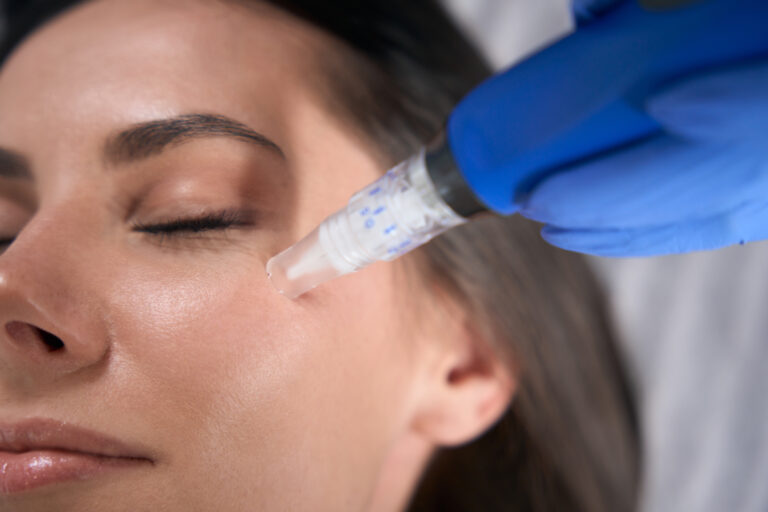
The FDA describes how the heat is delivered: each microneedle produces a small area of intense heat at its tip, at a set depth within or under the skin.
The safety difference
This is the part most comparisons leave out. In October 2025 the FDA said it was aware of serious complications with RF microneedling used for skin tightening, resurfacing or rejuvenation, including burns, scarring, fat loss, disfigurement and nerve damage, some needing surgical repair. Its evaluation is ongoing.
The FDA’s advice is to choose a licensed provider with training and experience in RF microneedling, to ask which device will be used, and to treat it as “a medical procedure, not a cosmetic treatment.”
Standard microneedling has risks too. The FDA lists redness, dryness, peeling, bruising and bleeding as common, and pigment changes, cold sore reactivation and infection as less common.
Which suits which concern?
- Acne scars. Standard microneedling has FDA authorization for facial acne scars. The AAD says three to five sessions may be needed, two to four weeks apart.
- Skin laxity. The AAD lists sagging skin among the uses of microneedling, and says added heat can increase collagen production. Weigh that against the FDA’s safety communication.
- Dark spots and melasma. The AAD lists microneedling among treatments for these. The FDA lists pigment changes as a risk, so this needs a provider experienced with your skin tone.
- Texture and pores. Either may be used.
Skin tone
The AAD says microneedling, including the radiofrequency type, is safe for all skin tones. The FDA notes a risk of darkening or lightening in darker skin types and that some authorized devices were not studied in darker skin. Ask your provider what experience they have with skin like yours.
Who should avoid both
The FDA says microneedling may not be suitable if you have a bleeding disorder or take blood thinners, have a weakened immune system or uncontrolled diabetes, have an active skin infection or cold sore, have eczema, psoriasis or a history of keloids, have taken isotretinoin in the past six months, or are pregnant or breastfeeding.
Frequently asked questions
Is RF microneedling better than microneedling?
It adds heat, which may increase collagen production. Whether that is better for you depends on your concern and on how you weigh the additional risks.
Which has less downtime?
The AAD describes downtime for microneedling as minimal, settling in a few days to a week. We did not find an authoritative comparison of the two.
Can either be combined with PRP?
The AAD describes microneedling with platelet-rich plasma for acne scars. The FDA states that microneedling devices are not approved for delivering blood products such as PRP into the skin. Ask your provider how the two would be used.
Next step
You can read our guides to SkinPen microneedling and RF microneedling, see the treatment pages for SkinPen and LegendPro RF microneedling, or book a consultation.
Sources
- American Academy of Dermatology. Microneedling can fade scars, uneven skin tone, and more.
- U.S. Food and Drug Administration. Microneedling Devices.
- U.S. Food and Drug Administration. Potential Risks with Certain Uses of Radiofrequency (RF) Microneedling: FDA Safety Communication. October 15, 2025.

Double Board Certified Nurse Practitioner
Beauté Medical Aesthetics